
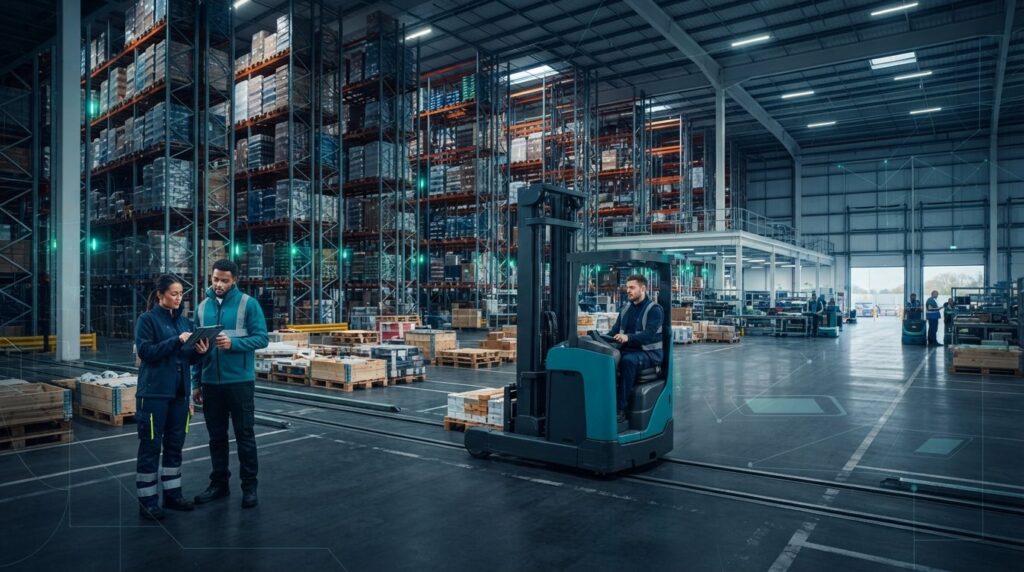
Is your warehouse lease actually a ceiling on your business growth? With UK prime warehouse rents rising steadily and the National Living Wage increasing each year, the cost of maintaining your own facility has never been higher. Finding the right pallet storage solutions uk is no longer just about floor space; it’s about operational agility.
You’ve likely felt the frustration of running out of room during peak season, only to pay for empty racking in the quiet months. It’s a cycle that drains capital and limits your ability to scale. This 2026 buyer’s guide helps you discover the most cost-effective and scalable pallet storage solutions in the UK to streamline your inventory management and accelerate business growth. We will break down the true cost of ownership in the current market, compare flexible 3PL models against rigid commercial leases, and show you how to gain real-time visibility over every pallet. By the end, you’ll know exactly how to align your storage costs with your actual sales volume and remove the friction from your logistics.
Key Takeaways
- Learn how to trade rigid warehouse leases and heavy capital expenditure for a flexible storage model that scales exactly with your sales volume.
- Identify the most effective pallet storage solutions uk for your business, comparing standard wide-aisle accessibility with high-density narrow-aisle configurations.
- Reveal the hidden costs of managing your own facility, from the latest 2026 business rates multipliers to the rising expense of statutory equipment inspections.
- Understand how to calculate your pallet positions accurately to avoid paying for dead space while ensuring you never run out of room during peak seasons.
- Discover the benefits of integrating your storage with a modern fulfilment platform to gain total visibility and streamline your supply chain from arrival to despatch.
Understanding Pallet Storage Solutions in the UK
Palletised storage is the engine of the UK supply chain. It transforms chaotic floor space into a structured, vertical asset. Most e-commerce brands start by stacking boxes on the floor, but this quickly leads to damaged stock and inefficient picking. Moving to professional pallet storage solutions uk allows you to reclaim your footprint. You stop paying for square footage and start utilising cubic volume. This transition is essential for any business planning to scale beyond a small unit.
The shift from floor-stacking to vertical racking systems is about more than just space. It is about stock integrity. When products are palletised and racked, they are protected from the weight of other boxes and the hazards of a busy warehouse floor. This methodical approach ensures that every item is accessible, searchable, and safe.
Why Your Business Needs a Dedicated Pallet Strategy
As your order volume grows, shipping individual parcels to your warehouse becomes expensive. Transitioning to bulk palletised inventory significantly reduces your cost per unit. It is a simple equation: more products in less space equals better margins. Adopting robust pallet storage solutions uk is the most direct way to lower your operational overheads while preparing for rapid growth.
Safety is another critical driver. Stacking pallets vertically requires precision and adherence to UK health and safety regulations, specifically the HSE HSG76 guidelines. Professional racking ensures your team stays safe while your inventory remains organised. It eliminates the “lost stock” syndrome that plagues unmanaged warehouses. Proper planning starts with the pallet itself. The standard UK pallet measures 1200mm by 1000mm. This differs from the smaller Euro pallet. Understanding these dimensions is vital for choosing the right pallet racking configurations to maximise your capacity. If your racking is not designed for the 1000mm width, you risk wasted space or unstable loads.
Key Terminology: FIFO, LIFO, and SKU Management
Effective storage relies on logic. First-In, First-Out (FIFO) is the gold standard for e-commerce, especially for goods with expiry dates or seasonal trends. It ensures your oldest stock leaves the building first. Conversely, Last-In, First-Out (LIFO) might suit non-perishable bulk items where access to the front of the rack is the priority. Organising your warehouse by palletised SKUs simplifies your stocktakes. Instead of counting individual items, you audit full pallet positions. This precision reduces errors and gives you a clear picture of the capital tied up in your inventory. It removes the friction from your daily operations and allows you to focus on selling.
In-House Warehousing vs. 3PL Pallet Storage Solutions
Choosing between managing your own facility and outsourcing is the most significant financial decision an e-commerce brand makes. While buying physical racking might look like a simple one-off cost, it is often a trap. You are not just buying steel; you are buying a long-term commitment to a lease, business rates, and maintenance. Many brands find that these fixed costs quickly become a ceiling on their growth.
In-house pallet storage solutions uk come with a long tail of expenses. You must account for commercial business rates, which for the 2026/27 tax year are subject to a multiplier of 48.0p for most warehouses. Then there is the forklift. Leasing, charging, and maintaining a reach truck adds hundreds of pounds to your monthly bill before you have even shipped a single order. These hidden costs transform a “cheap” DIY solution into a heavy financial burden.
The Pros and Cons of DIY Warehouse Management
Managing your own space gives you total physical control, but it creates an operational burden. You need dedicated staff to unload lorries and manage pallet movements. With the UK National Living Wage rising each year, labour costs can quickly erode your margins. You also inherit the legal responsibility for safety. You must follow strict HSE warehousing and storage guidelines, which mandate regular expert inspections and structural audits. Failure to comply is not just a safety risk; it is a legal liability that requires constant management attention.
Consider your growth trajectory. If you hold 50 pallets in July but need 500 by November, a fixed-lease warehouse fails you. You either pay for empty space in the summer or run out of room during the Christmas peak. This rigidity is the enemy of modern e-commerce. It forces you to make decisions based on floor space rather than customer demand.
Why 3PL Storage is the Engine of Scalability
Modern 3PL solutions remove these barriers. You transition from capital expenditure (CAPEX) to a flexible operational expenditure (OPEX) model. You only pay for the pallet spaces you actually occupy. This pay-as-you-go approach lets you scale without signing a three-year commercial lease or investing in expensive material handling equipment. By integrating your storage with ecommerce fulfilment UK, you bridge the gap between bulk storage and rapid dispatch. Every pallet is ready for immediate picking, reducing the time between a customer clicking ‘buy’ and the lorry leaving the dock.
If you want to stop managing facility overheads and start focusing on your product, exploring a managed service is the logical next step. You can scale your operations with a partner that provides the infrastructure you need exactly when you need it.
Technical Racking Types and Their Applications
Selecting the right configuration for your warehouse is a balance between density and accessibility. Not all pallet storage solutions uk are created equal. The hardware you choose dictates how quickly your team can pick orders and how much stock you can fit into every square metre. For most brands, Wide Aisle Pallet Racking is the starting point. It is the most accessible standard, allowing standard counterbalance lorries or reach trucks to navigate 3.5m aisles with ease. While it offers lower density, every pallet remains immediately accessible, which is vital for high-SKU e-commerce environments.
If floor space is at a premium, Narrow Aisle Racking or Very Narrow Aisle (VNA) systems offer a high-density alternative. By reducing aisle widths from 3.5m to as little as 1.6m, VNA configurations can increase your storage capacity by up to 40%. However, this requires specialised turret lorries or man-up pickers. For brands dealing in bulk single-SKU inventory, Drive-In and Push-Back racking allow you to store pallets deep within the structure. These are excellent for buffer stock but trade off immediate accessibility for sheer volume.
Choosing the Right Rack for Your Product Turnover
Your racking layout should mirror your sales velocity. High-velocity goods belong in accessible ‘pick faces’ at ground level, where they can be reached without heavy machinery. A professional fulfilment centre UK will typically organise racks to ensure the most popular items are closest to the packing stations. This reduces travel time and speeds up dispatch. Deep-storage solutions like Drive-In racking are better suited for seasonal buffer stock that you won’t need to touch for several months. By separating your active pick face from your bulk storage, you maintain a fluid operational rhythm even during peak periods.
Safety and Compliance Standards
Safety is the foundation of any racking installation. In the UK, you must adhere to the Storage Equipment Manufacturers’ Association (SEMA) guidelines. These standards ensure that racking is designed, installed, and maintained to handle specific loads. The UK Warehousing Association (UKWA) highlights that compliance is a legal requirement under PUWER regulations. You must ensure that weight loading notices are clearly displayed on every rack. Never guess the weight of a pallet; an overloaded beam is a catastrophic failure waiting to happen. You are also required to conduct an annual formal inspection by a SEMA Approved Racking Inspector (SARI) to identify structural defects before they become hazards. These safety protocols are essential for protecting your staff and your inventory investment.

Calculating Your Pallet Storage Needs and Costs
Planning your pallet storage solutions uk requires more than just counting boxes. You must forecast based on your sales cycle and stock turnover. If you sell 500 units a month, your storage needs depend on your replenishment frequency. Ordering a full container once a quarter requires significantly more pallet positions than smaller, weekly deliveries. You must align your storage footprint with your supply chain rhythm to avoid paying for empty air.
Beyond the rack space, you have to account for ‘Handling Fees’. Often referred to as RH&D (Receipt, Handling, and Despatch), these fees cover the labour and equipment costs of moving a pallet from a lorry into its designated position. Coordinating with dependable haulage and courier providers like NS Logistics Solutions Limited helps streamline these inbound and outbound transit movements. Insurance is another critical calculation. You need to distinguish between static warehouse insurance, which protects your stock while it is stored, and goods-in-transit insurance. Ensuring your provider has the correct cover is essential for protecting your balance sheet against unforeseen events.
The Formula for Space Optimisation
Aisle width is the most significant variable in space optimisation. A standard counterbalance lorry requires roughly 3.5m to turn safely, whereas a reach truck can operate in 2.7m. By choosing the right equipment, you can fit more rows into the same floor area. You also need to look up. UK warehouses often have high ceilings; utilizing the full vertical height can double your capacity without increasing your ground rent. The utilization rate is the percentage of total pallet positions occupied by inventory, directly determining how efficiently you convert warehouse overheads into profit.
Budgeting for Seasonal Stock Peaks
Peak season planning is where many e-commerce brands struggle. During Q4, you typically need 30% more space than your annual average to accommodate Black Friday and Christmas inventory. If you manage your own warehouse, this often leads to ‘dead stock’ issues, where slow-moving items take up valuable positions needed for high-velocity goods. A professional 3PL allows you to absorb these seasonal surges. You gain the elasticity to expand your footprint in November and shrink it back in January, keeping your costs strictly aligned with your revenue.
Ready to see how much you could save with a flexible, tech-driven model? Get a tailored storage quote today.
EZ3PL: Modern Pallet Storage Integrated with Fulfilment
Static storage is a legacy concept. In a modern e-commerce environment, your pallet storage solutions uk must do more than hold stock; they must drive sales. EZ3PL Ltd bridges the gap between bulk warehousing and individual customer satisfaction. We transform your pallets into delivered orders through a tech-driven approach that prioritises speed and accuracy. By locating your inventory within our UK-based facilities, you gain immediate access to national coverage and global shipping lanes without the friction of managing a physical site.
Visibility is the core of our platform. You no longer need to call a warehouse manager to check stock levels. Our dashboard provides real-time tracking of every pallet position, giving you total control over your inventory from any device. This transparency allows for seamless pick and pack operations. We break down your bulk arrivals and prepare them for individual despatch the moment an order hits your system. It is a fluid, rhythmic process designed to keep your business moving at the pace of the digital market.
Technology-First Inventory Management
We simplify the complex. Our system integrates directly with your Shopify, Amazon, or WooCommerce storefront, ensuring your stock levels are always in sync. This automation eliminates manual data entry and reduces the risk of overselling. You receive automated low-stock alerts that trigger your next pallet shipment exactly when needed. Our pricing model mirrors this simplicity. EZ3PL Ltd offers volume-based storage fees with no hidden surcharges, allowing you to forecast your margins with precision. You only pay for the space you use, turning your storage into a scalable asset rather than a fixed liability.
The Future of Your Logistics
Scalability is built into our DNA. Whether you are storing 10 pallets or 10,000, our infrastructure grows with you. This flexibility is essential for brands utilising our amazon fba prep service uk, where compliance and timing are everything. We handle the labelling and preparation to meet strict marketplace standards, allowing you to focus on brand growth while EZ3PL Ltd manages the heavy lifting. Your logistics should be an engine for expansion, not a bottleneck. We invite you to a direct consultation to discuss how our pallet storage solutions uk can simplify your inventory management and accelerate your growth.
Scale Your Logistics with Confidence
Navigating the complexities of warehouse management shouldn’t slow your brand down. You’ve seen how moving from rigid commercial leases to flexible pallet storage solutions uk protects your margins and unlocks new growth. By choosing a model that prioritises tech-driven visibility over physical ownership, you eliminate the friction of facility management and statutory compliance. Whether you’re managing seasonal surges or expanding your core range, your storage footprint should always match your sales pace.
EZ3PL provides the engine for this scalability. We offer seamless integration with major UK marketplaces, ensuring your inventory is always in sync with your shopfront. With our flexible volume-based pricing and expert pick and pack operations, you can focus on building your brand while we handle the heavy lifting. It’s time to trade operational chaos for streamlined efficiency.
Ready to simplify your supply chain? Get a Scalable Pallet Storage Quote from EZ3PL today and start growing without limits.
Frequently Asked Questions
What is the standard size of a pallet for UK storage?
The standard UK pallet measures 1200mm by 1000mm. This is often referred to as the ISO 2 or EUR 2 pallet. It differs from the continental Euro pallet, which is narrower at 800mm. Most pallet storage solutions uk are designed specifically around these 1200mm x 1000mm dimensions to maximise racking efficiency. Using the correct standard ensures your stock fits safely within national distribution networks and avoids wasted space.
How much does pallet storage cost per week in the UK?
Commercial rates for pallet storage in the UK are charged per pallet, per week, with the exact cost depending on your total volume and the specific requirements of your goods. High-volume contracts often secure lower rates, while flexible, low-volume arrangements sit at the higher end. You should also account for VAT and potential surcharges for specialised goods. Request a volume-based quote to see how costs scale with your inventory.
What is the difference between a warehouse and a fulfilment centre?
A warehouse is primarily a space for long-term, passive storage of bulk goods. If your operation prioritises straightforward commercial freight and holding solutions, check out Nikos Transport & Storage for dedicated logistics and space. In contrast, a fulfilment centre is a high-activity hub designed to turn inventory into delivered orders. While both offer storage, a fulfilment centre integrates technology to manage pick and pack operations, returns, and marketplace syncing. It acts as an active engine for your e-commerce growth rather than just a static room for your pallets.
Do I need my own insurance for goods stored in a 3PL warehouse?
Yes, you generally need your own insurance for the physical goods. While a 3PL provider maintains building insurance and public liability, their standard terms often limit their liability for the replacement value of your stock. You should ensure you have a robust policy covering “goods in storage” and “goods in transit.” This protects your balance sheet against unforeseen events like fire, theft, or damage during the fulfilment process.
Can I store oversized or non-standard pallets in a UK facility?
Most UK facilities can accommodate oversized or non-standard pallets, though they often require floor-stacking rather than standard racking. If your pallets exceed the 1200mm x 1000mm footprint or are significantly taller than 1.6m, you may face additional surcharges. These items take up more “cubic footprint” and can disrupt standard aisle configurations. Always provide exact dimensions to your provider to ensure they have the appropriate space and equipment for handling.
How quickly can I access my stock once it is palletised and stored?
Access speed depends on the provider’s technology. With a tech-driven platform, you have real-time visibility over your inventory and can trigger despatches immediately. In a professional pallet storage solutions uk environment, stock is logged into a Warehouse Management System (WMS) upon arrival. This allows for same-day or next-day picking once an order is received. Traditional warehouses may require 24 to 48 hours’ notice for manual stock movements or bulk withdrawals.
What are handling fees and why are they charged separately from storage?
Handling fees, often called RH&D (Receipt, Handling, and Despatch), cover the physical labour and equipment used to move goods. This includes unloading lorries, logging stock into the system, and placing pallets into racks. These are charged separately from storage because they represent a one-off operational cost per movement. Storage fees are recurring charges for the space occupied, whereas handling fees reflect the active work performed by the warehouse team.
Is 3PL pallet storage suitable for small businesses with only a few pallets?
3PL storage is ideal for small businesses because it eliminates the need for expensive warehouse leases. You can start with just a few pallets and scale your footprint as your sales grow. This “pay-as-you-go” model provides access to professional infrastructure, expert staff, and discounted courier rates that would be impossible to manage in-house. It allows smaller brands to compete with larger retailers by professionalising their logistics from day one.


